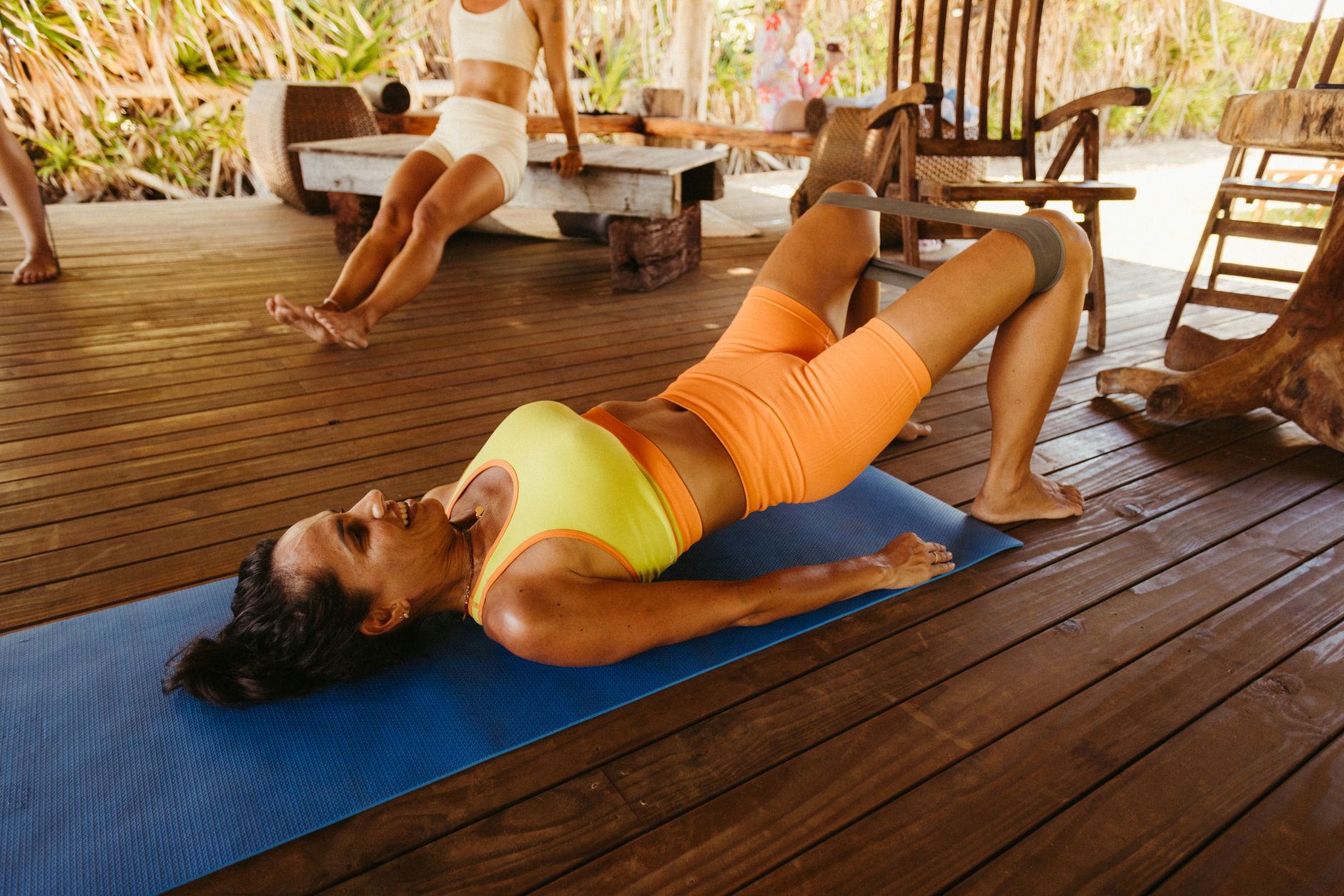
Start Here: Your 6-Minute Glute Activation Warm-Up
Before leg day, do 2 rounds of glute bridges, banded lateral walks, bodyweight hip hinges, and kickbacks. Keep it light, feel the muscle working, then start your real workout.
That is enough.
Glute activation is not supposed to be a second workout. It is a short warm-up that helps you feel your glutes before hip thrusts, squats, lunges, Romanian deadlifts, and cable work.
Use this before lower-body days:
| Exercise | Reps | What to feel |
|---|---:|---|
| Glute bridge | 12-15 | Glutes squeezing hard at the top |
| Banded lateral walk | 10-12 each way | Side glutes, not knees or feet |
| Bodyweight hip hinge | 10 | Glute and hamstring stretch |
| Standing kickback | 10-12 each side | Glute max without lower-back arching |
Rest just enough to keep the reps clean. Then move into your first lift.
What Glute Activation Actually Means
Glute activation means using a few easy exercises to wake up the glutes before harder training.
It does not mean your glutes are asleep forever. It means your body may be defaulting to quads, lower back, or hamstrings because those muscles are easier for you to feel.
The goal is simple: make the first working set feel less random.
A good glute activation drill should do three things:
- warm up your hips
- help you feel the target muscle
- improve control before loading heavier exercises
If an activation drill burns so much that your real workout gets weaker, you did too much.
The Best Glute Activation Exercises
These are the ones worth using.
1. Glute Bridge
The glute bridge is the easiest place to start because it teaches hip extension without much setup.
How to do it:
- Lie on your back with knees bent.
- Place feet about hip-width apart.
- Keep ribs down and abs lightly braced.
- Push through your heels.
- Squeeze your glutes at the top for 1 second.
- Lower with control.
Do 12 to 15 reps.
If you feel your lower back more than your glutes, tuck your pelvis slightly and stop arching at the top. Your hips should extend. Your spine should not turn into the movement.
2. Banded Glute Bridge
Add a mini band above your knees if regular bridges feel too easy.
Push your knees slightly out against the band while you bridge. Do not let the band pull your knees inward.
This makes the glute medius help more, which is useful before squats, lunges, and leg press.
Do 10 to 15 reps with a short pause at the top.
3. Banded Lateral Walk
Banded lateral walks are great for the side glutes.
Put a mini band above your knees or around your ankles. Sit into a small athletic stance, keep your toes mostly forward, and step side to side without bouncing.
The mistake is turning this into a weird foot shuffle. Stay controlled. Keep tension on the band the whole time.
Do 10 to 12 steps each direction.
4. Standing Glute Kickback
This is a low-friction way to feel the glute max before hip thrusts, RDLs, or cable kickbacks.
Hold onto a rack or wall. Keep your ribs down. Drive one heel back until your glute squeezes, then return slowly.
Keep the range small enough that your lower back stays quiet.
Do 10 to 12 reps each side.
5. Bodyweight Hip Hinge
A hip hinge teaches your glutes and hamstrings to load before Romanian deadlifts.
Stand tall, soften your knees, push your hips back, and keep your spine long. You should feel a stretch in your hamstrings and glutes, not pressure in your lower back.
Do 10 slow reps.
This one is especially useful if RDLs usually feel awkward.
6. Clamshell
Clamshells are useful if your knees cave in during squats, lunges, or hip thrusts.
Lie on your side with knees bent. Keep feet together and open the top knee without rolling your hips backward.
Use a small range. The point is control, not how far your knee can fly open.
Do 12 to 15 reps each side.
7. Frog Pump
Frog pumps create a big glute squeeze with almost no setup.
Lie on your back, put the soles of your feet together, let your knees open, and bridge up. Pause at the top.
Use these when you want a quick glute pump before hip thrusts or split squats.
Do 15 to 20 reps.
A Simple Glute Activation Routine Before Leg Day
Use this before a glute-focused lower-body workout:
| Move | Sets | Reps |
|---|---:|---:|
| Glute bridge | 2 | 12-15 |
| Banded lateral walk | 2 | 10 each way |
| Bodyweight hip hinge | 2 | 10 |
| Standing kickback | 1-2 | 10 each side |
This should take 5 to 7 minutes.
After that, start your main lift. If your workout begins with hip thrusts, do a lighter warm-up set before your first real set. If your workout begins with squats or leg press, keep your first few sets controlled and do not rush to heavy weight.
When Should You Do Glute Activation?
Do glute activation before:
- glute days
- leg days where quads take over
- hip thrusts
- Romanian deadlifts
- lunges or split squats
- cable glute work
You do not need it before every workout forever.
Use it when it improves your first working sets. Skip it when you already feel warm, stable, and connected to the right muscles.
How Much Glute Activation Is Too Much?
Too much activation is when your glutes are tired before the workout starts.
Keep activation sets easy. You should feel warmer and more coordinated, not cooked.
Use this rule:
- 5 to 7 minutes before training is enough
- stop each drill before it turns into a grind
- save hard sets for the actual workout
If you do 20 minutes of band circuits before hip thrusts, do not be surprised when your hip thrusts feel weaker.
What If You Still Cannot Feel Your Glutes?
If activation drills do not help, the issue is probably exercise setup, load, or technique.
Try these fixes:
- use lighter weight for the first working set
- slow down the lowering phase
- pause where the glute should work hardest
- film the exercise from the side
- check your foot position
- stop chasing range of motion your hips cannot control
For example, if hip thrusts only hit your lower back, your ribs may be flaring and your pelvis may be dumping forward. If RDLs only hit your back, the weight may be drifting away from your body or your hinge may be too deep.
Activation helps. It does not replace good form.
Glute Activation vs Glute Workout
Glute activation is practice. A glute workout is training.
Activation uses light resistance, short sets, and low fatigue. Training uses enough load and volume to force adaptation.
If you want bigger glutes, activation alone will not do it. You still need progressive lifts like hip thrusts, RDLs, squats, lunges, cable kickbacks, and abductions.
Use activation to make those exercises better.
Final Takeaway
Before your next leg day, do the 6-minute routine: glute bridges, banded lateral walks, bodyweight hinges, and standing kickbacks. Then start your real workout and log what you lifted.
That is the loop: feel the glutes, train them hard, recover, and add reps or weight over time.
If you want a simple way to build glute days, track your lifts, and know when to progress, Soma gives you the plan and the log in one place. You can also read Cable Glute Exercises: 7 Moves Worth Doing, Hip Thrust Guide: How to Do It for Bigger Glutes, and Glute Workout Plan for Women if you want your whole glute setup to make more sense.